Request a Quote for Custom Brass Parts: What to Send
A conversion-focused checklist for requesting a quote on custom brass parts — drawing, threads, grade, finish, quantity and packing — so you get a clear reply.

If you need a price on a non-catalogue brass component, the fastest path is a complete quotation request — not a long back-and-forth. This page is the practical checklist to request a quote for custom brass parts on Jamnagar.net: what to attach, what to write, and what happens after you submit.
Use the quotation form when you have a drawing or sample. Use the catalogue when a standard SKU is close enough. Use contact when you need a human routing question before the files are ready. Every path should end with one clear specification pack.
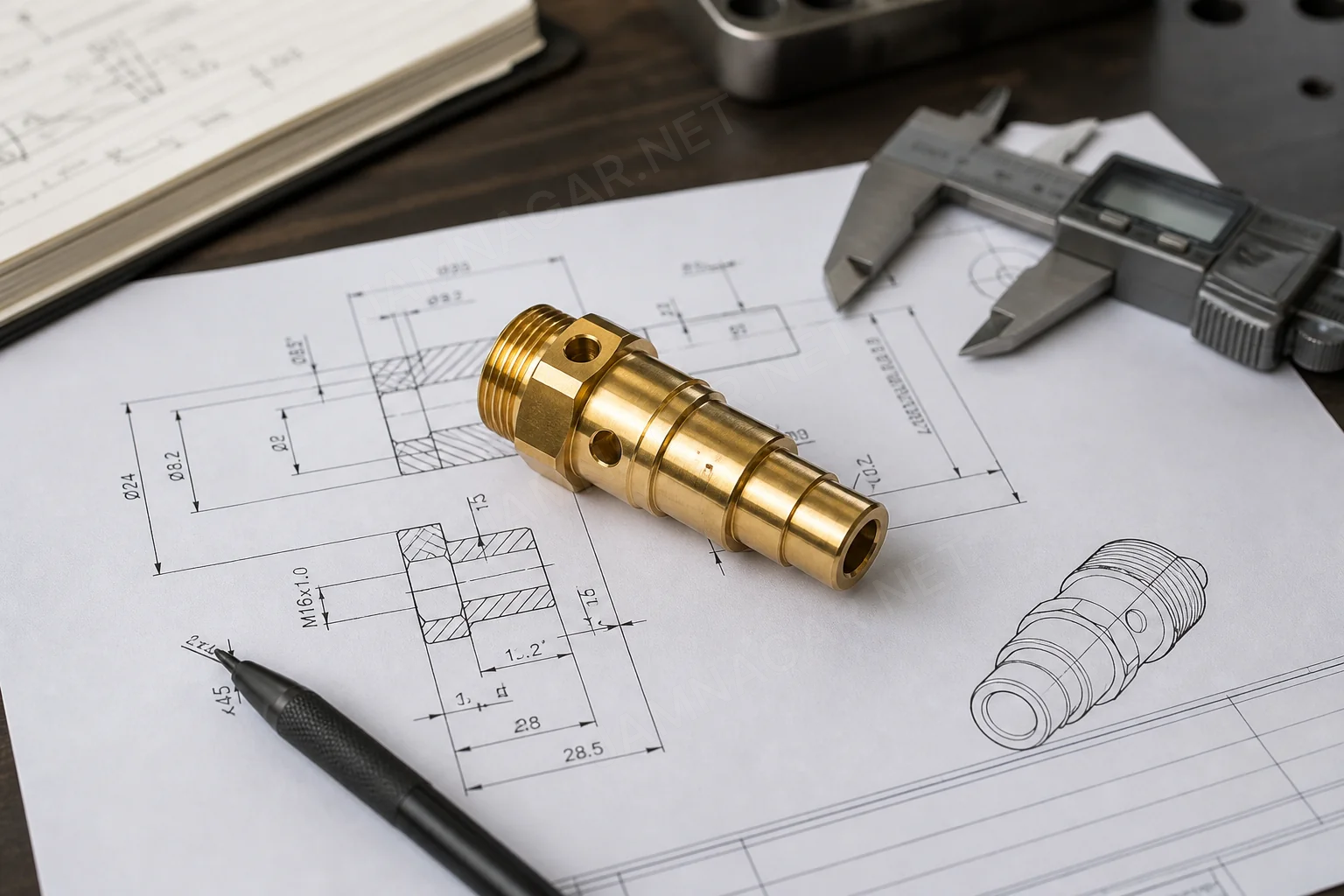
Custom vs catalogue — choose the lane
Custom does not always mean exotic. It often means a standard-looking adapter with one odd undercut, a special thread length, or a plating note your shelf SKU does not carry. Choose the lane that matches reality:
| Situation | Best path |
|---|---|
| Exact catalogue size / family exists | Shortlist on catalogue, then Get Price / quotation |
| Close to catalogue but odd undercut / thread | quotation with drawing + note the difference |
| Full custom geometry | quotation with 2D/3D or dimensioned sample photos |
| Only a physical sample | quotation with photos, critical dims, thread, material note |
| Files not ready, need routing help | Contact — then follow with quotation |
The quotation request pack that gets a clear reply
Send these fields in one submission. Missing one field usually means a clarifying email and a slower rate — and slower rates lose purchase cycles.
- Drawing or sample evidence — PDF/DXF/STEP or clear photos with scale
- Material / grade — CW614N, IS-319, free-cutting, or “propose machining brass”
- Thread standard — BSP, NPT, metric, UNC… plus size
- Critical tolerances — mark fit diameters; do not tighten everything blindly
- Finish — natural, nickel, tin, or other
- Quantity — trial and/or bulk; split lines if needed
- Delivery — city or port; export packing if required
- Your part number — for labels and future repeats
Conversion tip: One complete quotation beats three partial emails. Put grade, thread and quantity in the first message even if the drawing is attached.
Copy-paste quotation template
You can paste this into the notes field and fill the brackets. Keep one block per part number when geometries differ.
Part name / our code: [ ]
Drawing rev: [ ] / sample photos attached: [yes/no]
Material: [ ]
Thread: [ ]
Finish: [ ]
Critical dims: [ ]
Qty now: [ ] | Forecast: [ ]
Packing / label: [ ]
Delivery: [city/port]
Notes: [application or mating part]
What slows a quote (and how to avoid it)
| Problem | Fix |
|---|---|
| Photo only, no dimensions | Add critical mm values or a scale reference |
| Thread not named | Write standard + size; do not assume from image |
| Grade conflicts drawing vs email | Keep one material line everywhere |
| “Best price bulk” with no qty | Give trial qty and optional forecast |
| Multiple parts in one blurry photo | One line item per geometry |
| Finish said “good quality” | Name natural / nickel / other |
Multi-line BOMs and mixed catalogue + custom
You can put catalogue references and custom drawings on the same quotation. Number the lines. Mark which lines are catalogue SKUs and which are custom. If packing should be kit-wise for assembly, define the kit. If packing should be size-wise for warehouse bins, say that instead. Mixed intent without a packing note creates rework even when the machining is correct.
After you submit: what to expect
- We review geometry, thread, grade and quantity
- We ask only the clarifying questions that block a rate
- We quote commercially against the specification you sent
- We confirm packing notes when export or mixed SKUs are involved
- We keep trial and bulk as separate lines when you requested both
We will not invent ISO badges, “#1 manufacturer” claims or certifications you did not request. If your customer needs a certificate, say so on the quotation request so the commercial reply includes that expectation.
When to contact before quotation
Use contact when you need to ask how to split a large BOM, which category a part belongs to, or whether a sample shipment path makes sense. For pricing itself, the quotation request with files is still the working document. Contact starts the conversation; quotation finishes the specification handoff.
Buyer readiness checklist
| Ready? | Item |
|---|---|
| ☐ | Drawing revision or sample photos attached |
| ☐ | Thread + grade + finish written in notes |
| ☐ | Quantity now (and forecast if useful) |
| ☐ | Delivery city / port stated |
| ☐ | Part numbers for labels listed |
| ☐ | Contact path used only if files are not ready yet |
FAQ
Can I get a quote without a CAD file?
Yes — send dimensioned photos or a sample description. CAD is better for tight tolerances.
How many parts can I put on one quotation?
Multiple lines are fine. Number them and attach drawings per line when geometries differ.
Do you quote catalogue and custom together?
Yes. Mark which lines are catalogue references and which are custom drawings.
Is there a charge to quote?
Send the quotation request with specifications. Commercial discussion follows the enquiry; start with clear files.
What if I need NDA handling?
Say so when you contact or quotation. Share only what you are ready to share until that is agreed.
Where should I click first if I am unsure?
Skim the catalogue for a near match; if nothing fits, go straight to get a quotation.
Related reading
Related reading on Jamnagar.net: drawing checklist · low MOQ vs bulk production.
Next step — send the file
Custom brass quoting is a specification exchange. Attach the drawing, fill the template fields, and submit. If you need help routing the enquiry first, contact us — then follow with the quotation request so production has a single pack to work from. The strongest next action is still the same: request the quote with complete data.


