Brass Pipe Fittings Manufacturer: Threads, Grades & Quote Fields
A practical buying page for brass pipe fittings from Jamnagar — nipple, elbow, tee and adapter families, thread standards, finishes, and how to request a clean bulk quote.
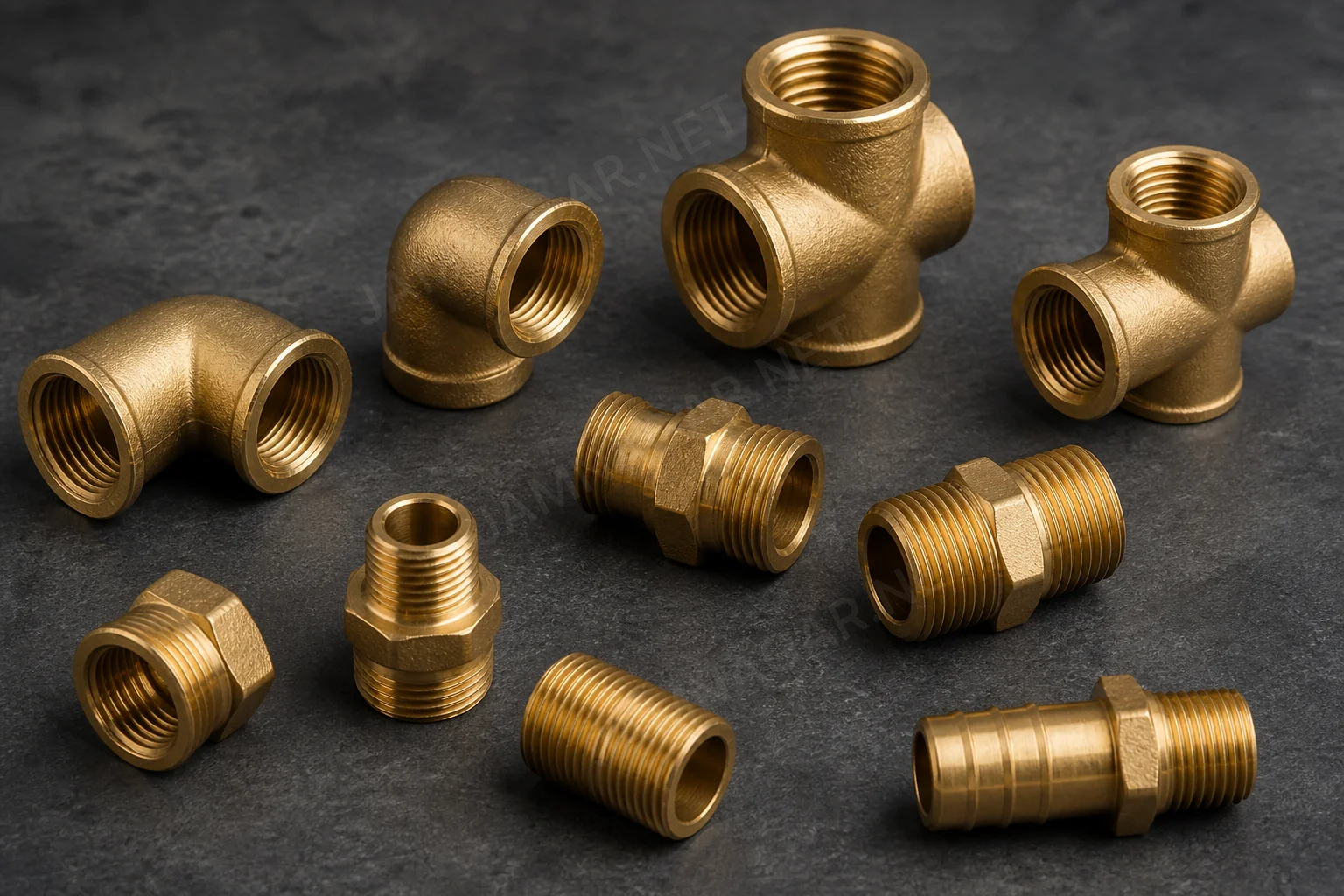
Pipe fittings look simple until a BSP male lands on an NPT female, or a “same size” elbow arrives with a different centre-to-end length than your jig expects. Buyers searching for a brass pipe fittings manufacturer need size discipline more than slogans.
Jamnagar.net quotes pipe-side brass components through the pipe fittings category. Sanitary tap-side parts remain in the sanitary category when you need bodies, spindles or related tap components. This article walks the commercial fields we need before a rate is useful — whether you are filling a merchant shelf or feeding an OEM assembly cell.
- Thread-standard clarity on every SKU line
- Size ranges for nipples, elbows, tees, unions and adapters
- Grade and finish callouts when water or export duty demands them
- Mixed-size cartons when traders consolidate several diameters
Fitting families buyers actually order
Most quotations cluster around a short list. Naming the family early stops the wrong workshop route and the wrong weight estimate. It also keeps your internal SKU codes aligned with what production will stamp on the carton label.
| Family | Typical use | What to state on quotation |
|---|---|---|
| Nipples & extensions | Straight joins, length correction | Male/female, length, thread |
| Elbows | Direction change in pipe runs | Angle, ends, centre dimensions if critical |
| Tees & crosses | Branch lines | Equal/reducing pattern, all three ends |
| Unions & couplings | Serviceable joints | Seat style, nut presence, seal notes |
| Adapters / reducers | Size or standard change | Both end standards and sizes |
| Compression / olive related | Tube systems | Tube OD, olive/nut requirement |
Thread standards — write them, do not imply them
In export and pan-India trade, the same nominal size can mean different thread forms. Put the standard in writing: BSP, NPT, metric, or another form your market uses. Reducing adapters that change both size and standard need both ends spelled out — photos alone are not enough.
If your customer prints “1/2 inch brass elbow” with no standard, ask them before you ask us. We will still need the answer to quote. Thread engagement length and chamfer style sometimes matter for automated assembly; if your jig is sensitive, include those notes rather than discovering them after the first carton opens.

How these fittings are usually made
Geometry decides the route. Many pipe fittings start as forged or cast blanks and finish with machining for threads and sealing faces. Smaller adapters and nipples may be fully turned from rod. Your job as buyer is not to prescribe every machine — it is to lock functional ends, pressure expectation if known, and finish.
When a fitting must match an existing moulded or stamped mating part, send that mating print or a measured sample. “Looks like our old elbow” is not a manufacturing instruction.
Shop-floor note: Sealing faces and thread runout decide leak performance more than polish on non-mating walls. If a face must be flat or a seat angle is special, mark it on the drawing; do not bury it in a chat message.
Materials and finishes for pipe work
Machining brass grades are common for many pipe fittings. Potable-water or aggressive media may need a different alloy discussion — raise it in the quotation request instead of assuming a default. Finish options typically include natural brass or plated surfaces when the assembly specification asks for them.
- Natural brass — common for many industrial lines
- Nickel or other plating — when appearance or surface duty requires it
- Special alloy requests — only when named by the buyer
If part of the batch ships natural and part ships plated, split the quotation request into two blocks. Blended finish language is how warehouses end up with unmarked mixed stock.
Buyer checklist before you hit send
| Check | Detail to include |
|---|---|
| SKU list or drawing set | One line per size / pattern |
| Thread standard each end | BSP / NPT / metric / other |
| Pressure or media notes | If known — helps catch missing specs |
| Finish | Natural / plated / none stated |
| Quantity by size | Avoids one blended “approx” rate |
| Packing preference | Poly bag, carton count, label language |
| Destination | City / port for logistics context |
Wholesale and OEM buying patterns
Traders often consolidate several diameters of the same pattern. OEMs usually lock one drawing and repeat. Both work — but mixed lists need a spreadsheet or clear line items. A single photo of “assorted elbows” produces a conversation, not a firm rate.
For assortment buys, sort lines by pattern first, then size. That order mirrors how cartons are picked and how shortages are reported. For OEM repeats, keep the drawing revision visible on every PO so a silent print change does not walk into production unnoticed.
Review current lines on the brass pipe fittings page before you attach custom drawings. For tap-side sanitary parts, use the sanitary category.
Quality language that stays practical
Ask for the checks you will actually perform on receipt: thread gauging on a sample, visual for cracks or folds, dimensional spot checks on centre-to-end if your jig cares. Do not paste a twelve-page aerospace protocol onto a commercial elbow unless that is truly your customer requirement — overstated QC language slows quotes without protecting you.
If you need lot identity on labels for your ISO paperwork, write the label fields. Production can follow a short label rule; it cannot invent your traceability scheme from silence.
Applications
Pipe fittings from this category serve plumbing assemblies, equipment water lines, general fluid transfer, and related industrial joins. Gas or specialised media may belong in other catalogue families — say so if the duty is not ordinary water or air. Export buyers should also note whether local thread conventions differ from the drawing origin country.
Equipment builders often need the same pattern in a short size run plus one odd adapter. Put the odd adapter on its own line with both ends written in full. That single habit prevents the “almost right” shipment that blocks a whole machine install.
Lead time and repeats
Repeating sizes with a locked drawing move faster than first-time patterns that need thread trials or plating samples. If you already hold an approved sample, reference it by date or code on the quotation request. If this is a new export market for you, tell us the destination early so packing and label language are priced once, not revised after cartons are ready.

FAQ
Can one quotation cover multiple sizes?
Yes. List each size and quantity on separate lines. That is faster than ten separate emails.
Do you supply only complete consumer bathroom sets?
No. The focus is industrial and trade fittings — components used by OEMs, plumbers’ merchants and assemblers.
What if I only have a sample?
Share measured threads, lengths and end types with photos. We can reverse-spec for quotation; a drawing still reduces risk.
How do you handle reducing fittings?
State both ends clearly (example: 3/4″ BSP male × 1/2″ BSP female). Ambiguous “reducer” labels delay quotes.
Is plating included in every price?
Only when the quotation request asks for it. Natural brass and plated lines are quoted differently.
Where should first-time buyers start?
Open the pipe fittings category, note matching SKUs, then use quotation for confirmation on grade, finish and packing.
Related reading
Related reading on Jamnagar.net: bulk plumbing fittings buying guide · thread and tolerance quality notes.
Close the loop
If sizes are known, send the list. If geometry is custom, attach the drawing. Either path beats a vague “need brass fittings” message that forces everyone to guess.


